
Introduction
This photo essay reviews the most important developments in mycelium material products and design projects over the last 10 years, with a particular focus on digital design methods for the production of large structures and installations.
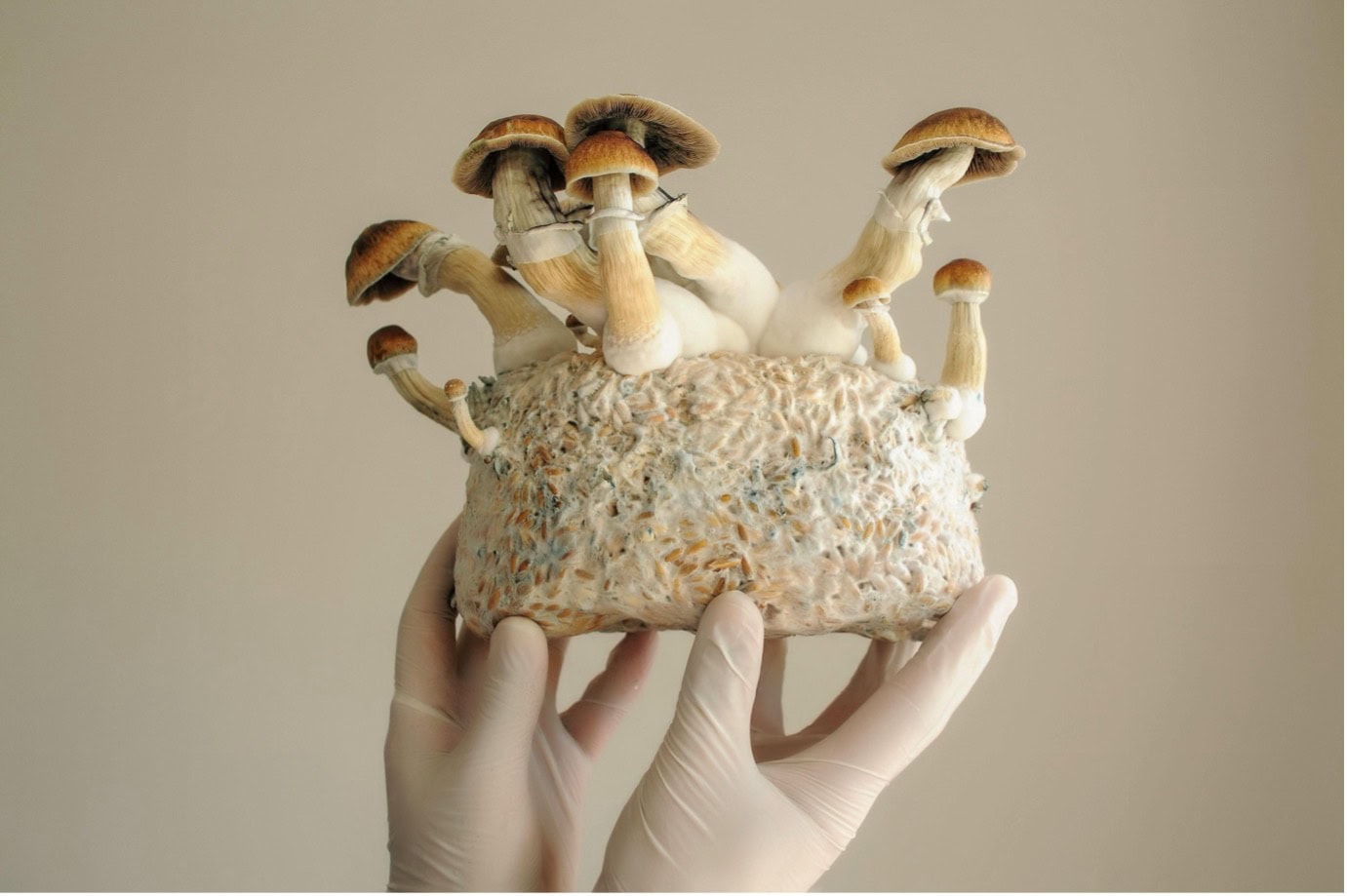
Mycelium is the root of a fungus made of branching-out structures called hyphae that can grow on various substrates. Substrates are sourced from any waste stream of organic and inorganic matter. The hyphae act as a natural binder around the substrate particles, forming a mycelium composite, which is a “lightweight material formed by drying or heating the mycelium colony, which ultimately results in the hibernation or death of the fungal mycelium.” (Mohseni & Rocha Viera, 2023) The formed mycelium-based composites are a foam-like material with a hard external skin.
Myco-materials are an international enterprise and are produced on an industrial scale. In this section I explore the market leaders in myco-material production such as mycelium fabrics and mycelium building products.
Mycelium Fabrics
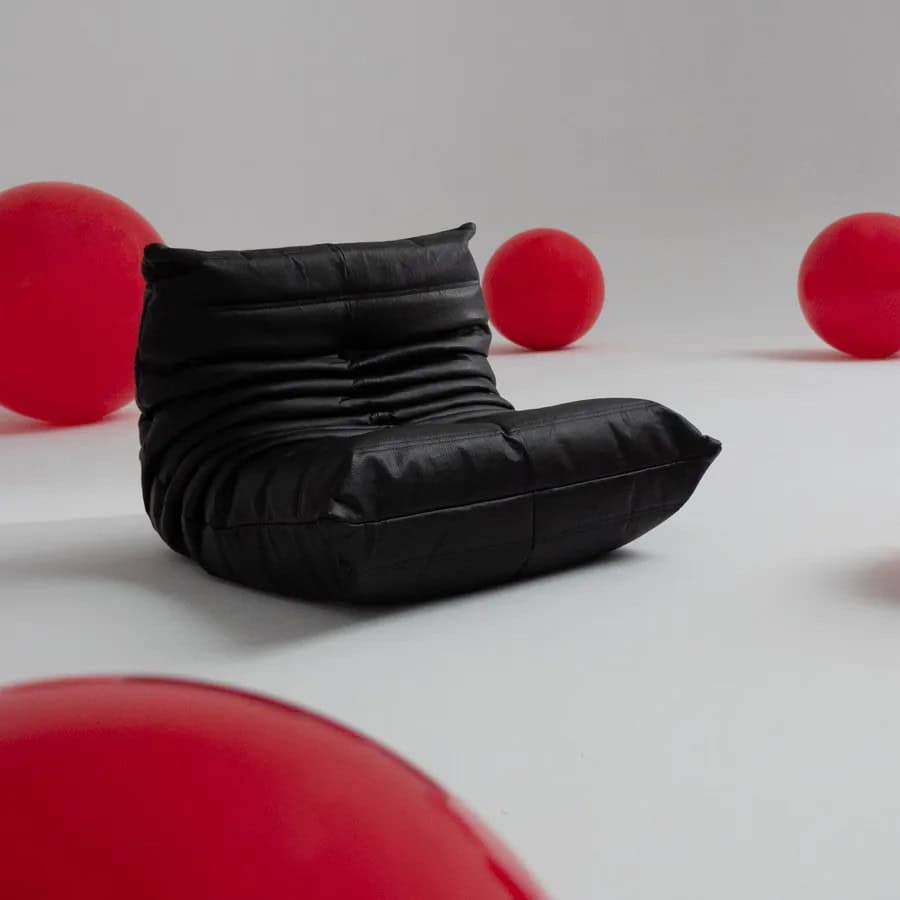
Mycoworks™ is an international producer of structural mycelium and fine mycelia. Reihi™ is Mycoworks™ mycelium leather brand used by the furniture company Linge Roset as an upholstery fabric. (Figure 03).
Building Products
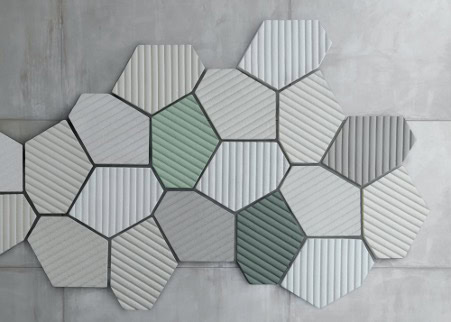
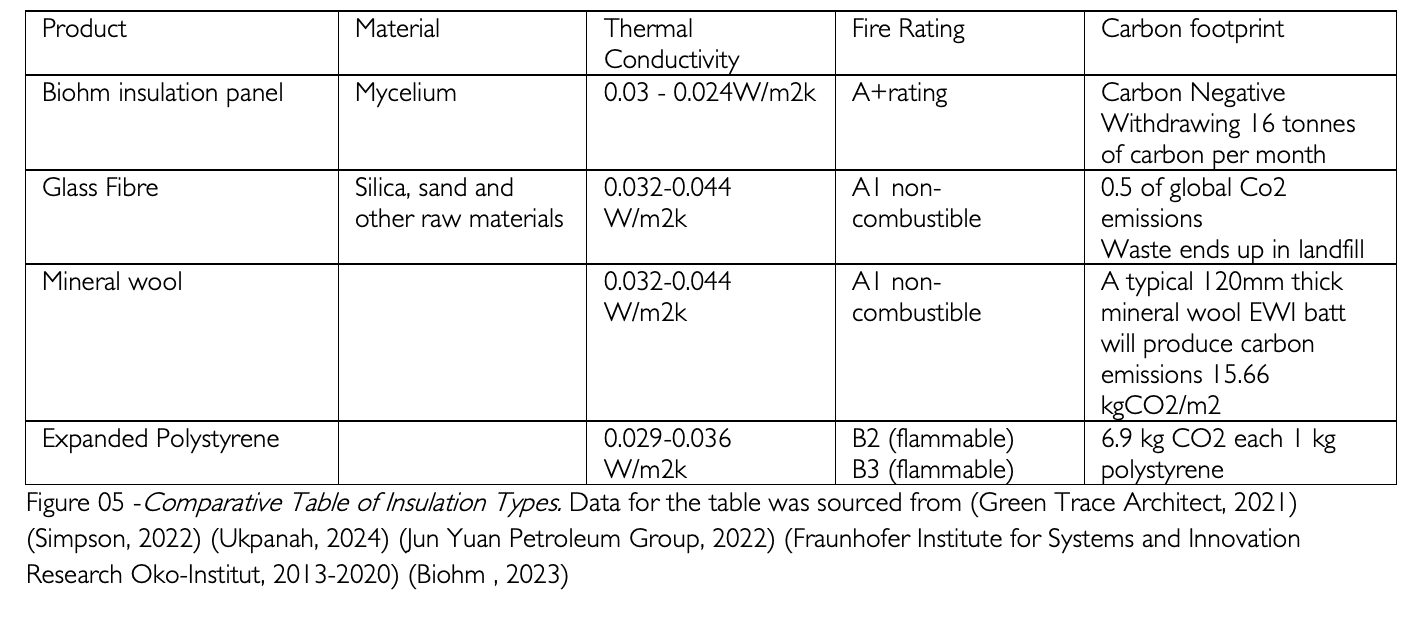
The award-winning biotechnology company Biohm™ is developing a mycelium strain that can consume plastic such as polyurethane and polyethene. Mycelium is nature’s recycler. Using waste plastic as a substrate, Biohm™ are producing mycelium insulation panels and eliminating waste simultaneously. Product literature shows that the mycelium insulation has a thermal conductivity of 0.03W/m.k to 0.024W/m.k and an A+ fire rating (Biohm, 2016). Furthermore, Biomhs insulation panels are a natural material, which does not contain the synthetic materials that cause the harmful toxic smoke (Green Trace Architect, 2021)
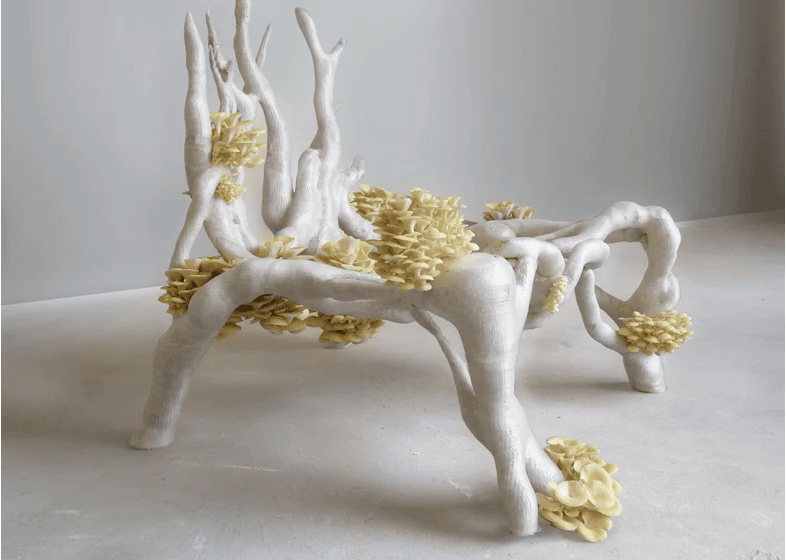
Ecovative™ was co-founded in 2007 and has developed and patented several methods of fabricating mycelium products. The company has also collaborated with supplying mycelium to design large bespoke structures. It is now one of the biggest suppliers of mycelium products, such as packaging materials, insulation boards, and food products, and it has developed AirMycelium™.
Grown Bio™, based in the Netherlands, produces mycelium bricks, insulation panels, acoustic panels, and mycelium grow kits. It can also collaborate with design teams to supply mycelium materials for bespoke projects such as the Growing Pavilion, which will be discussed later.
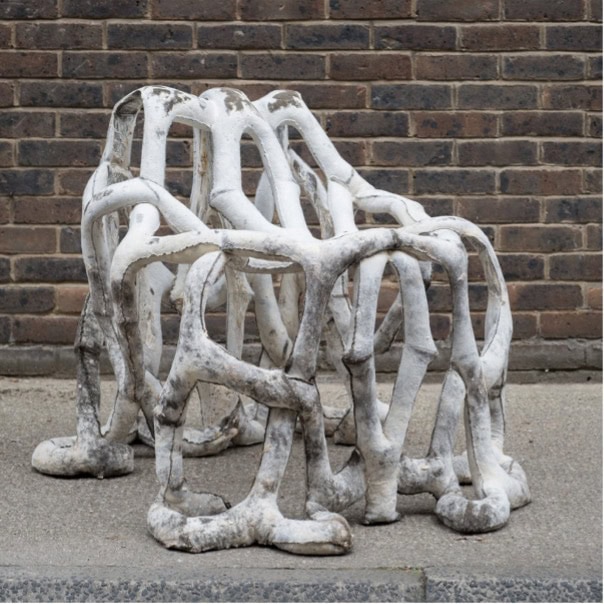
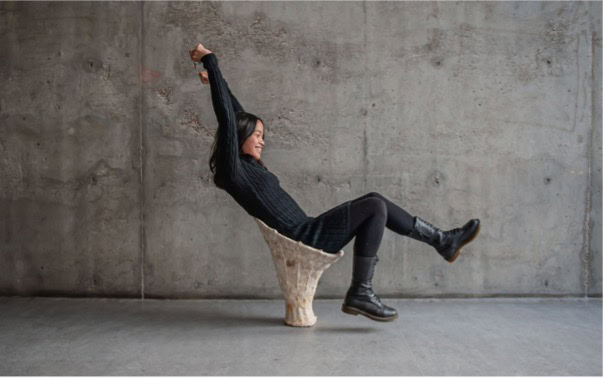
Further advancements in mould design and form have been developed by the Hub for Biotechnology in the Built Environment (HBBE). The MycoknitCompoSITe chair made using a kitted formwork as a mould. The mould was injected with Mycocrete (a mycelium paste) in semi sterile lab conditions and placed over a cardboard scaffold. The knitted formwork made of thin knitted tubes allowed the Mycocrete to breathe through the drying process, reducing shrinkage. After drying for approximately 8 days the chair to carry a body weight of approximately 70Kg.
The Growing Pavilion 2014
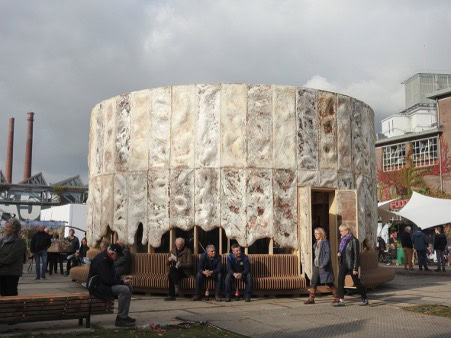
The Growing Pavilion designed by Biobase Creations a Dutch creative studio “that specialises in installations, projects and storytelling about the transition towards a regenerative and circular world.” (Biobased Creations, n.d.) The design team who designed the Growing Pavillion were cross-disciplinary led by Pascal LeBoucq. The circular structure made from a wooden framework filled with bespoke mycelium bound composite (MBC) supplied by GrowBio™. The design of the interior space was an exhibition that promoted the properties of mycelium in fashion, design and construction. This pop-up structure and temporary events space was part of Dutch Design Week 2019.
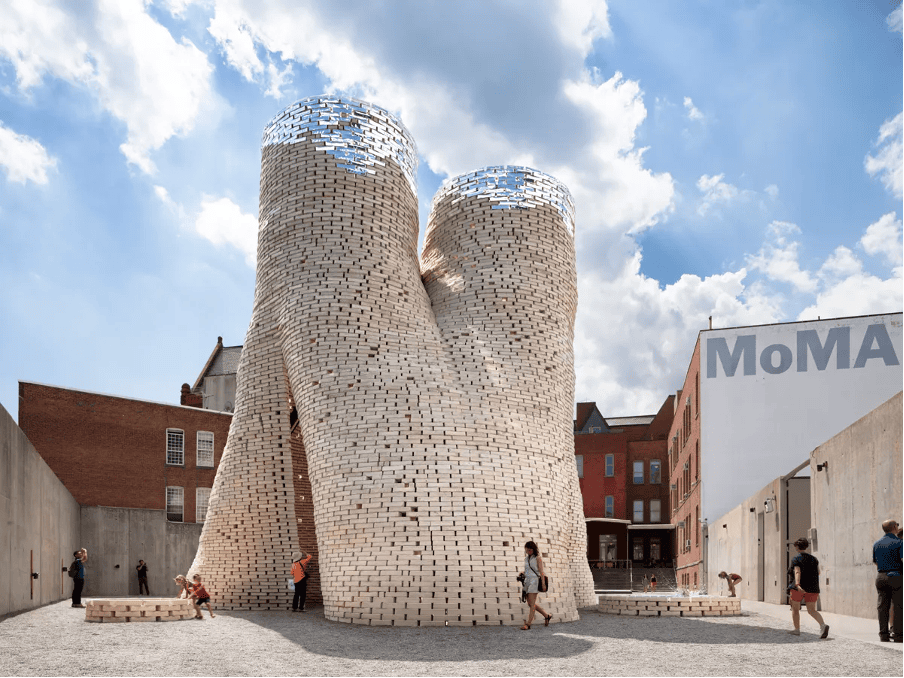
Mycotree was designed using structural geometry to compensate for the low strength of mycelium, which is weak in tension and bending. The team designed a structural form placing the mycelium in compression-only configurations (Dessi-Olive, 2022). “The mycelium portion of the structure is a metaphor for the load-bearing component of the building; the grid at the top represents the floor being supported” by the Mycotree.
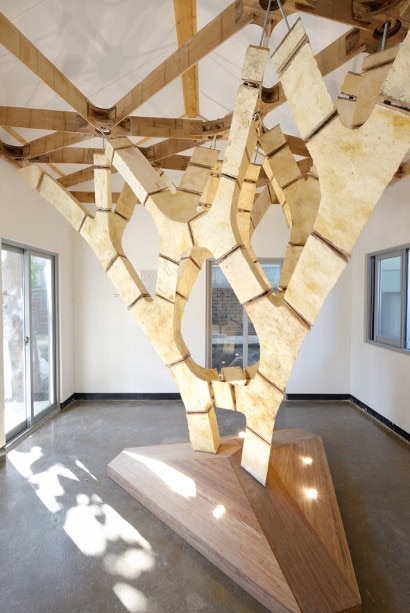
The Monolith Micelio – 2018 Academic Jonathan Dessi Olive Kansas State University
Monolith Micelio was an alternative response to block and brick construction. The structure was built in situ using formwork that “needed to be strong enough to support the wet substrate while maintaining the form” (Dessi-Olive, 2022). The design was grown from one ton of colonised hemp supplied by Ecoavative.
Building a site form outside exposed the untreated mycelium structure to the elements, causing it to crack, decay, and become “infected with unfavourable organisms and potentially dangerous moulds” (Dessi-Olive, 2022).
An alternative to the in-situ method when forming large structures is Bio-Welding or myco-welding. Meaning the growth process has two stages. Stage one, the smaller elements are grown in moulds; stage two, the elements are assembled to make a larger form. The large structure is kept in a sterile growth environment so the elements can naturally bond together, and the growth process is stopped by heat. (Dessi-Olive, 2022). Mycelium can also self-heal so the material can recover its original properties after damage (Elise Elsacker, 2021)
Mycocrete
Bioknit self-supporting structure was created in 2022 by the Living Textile Research Group. Lead by Jane Scott as part of the (HBBE) 3-Dimensional knitted forms. The tubular forms were designed on a knitting machine and filled with mycocrete-paste. The knitted formwork allows the oxygen to circulate better when the forms are drying hence, the structure shrank less when drying. “The combination of textiles and mycelium presents a compelling new class of textile biohybrid composite materials for new application in the construction sector” (Kaise, et al., 2023) The dome structure is 2000mm high.

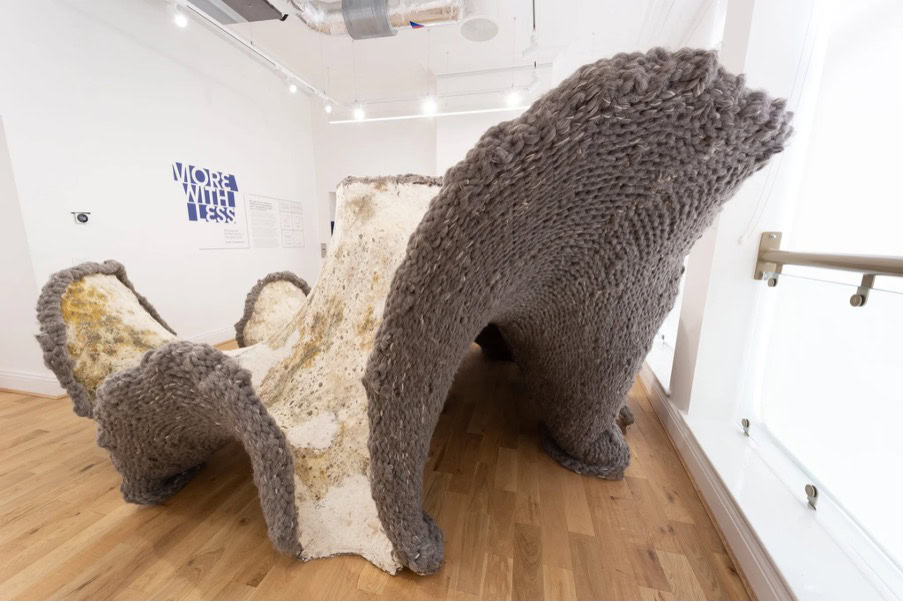
“The Living Room is a mycelium-knit biohybrid architecture consisting of an exposed knitted formwork on the interior and a smooth mycelium plaster on the exterior, creating a monolithic 4m freestanding structure.” (Jane, S. 2023, p208)
The wool knitted formwork for the living room structure was stretched between a scaffold structure. The wool was then covered with Mycocrete paste. Once the mycelium had grown and dried a large-scale free-standing “double curve structure” (Jane, S. 2023,) was formed. The Living Room was exhibited at ‘the more or less’ exhibition in the Farrell Centre 2023
Digital Manufacturing
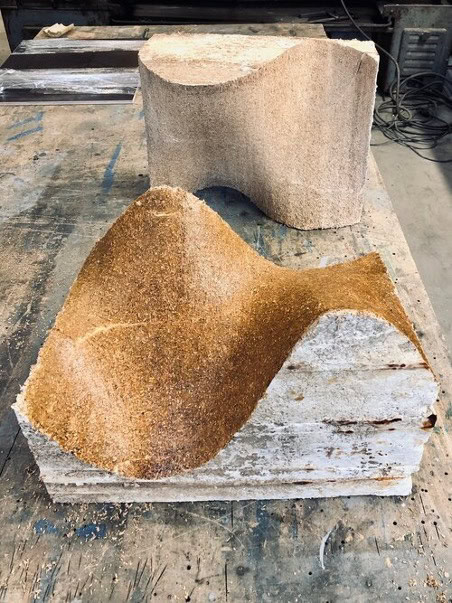
Digital manufacturing processes have not always been successful in mycelium. CNC milling cannot cut mycelium cleanly due to how the hyphae bind’s with the substrate. Six-axis robotic abrasive hotwire cutting was carried out on mycelium blocks formed from both dead and living mycelium blocks. After cutting the live mycelium block, the 2mm mycelial coating could regenerate on the cut planes of the block. (Elise Elsacker, 2021) This process produces negative and positive forms, opening up huge possibilities regarding the design of structures using large mycelium structures.
Blast Studio
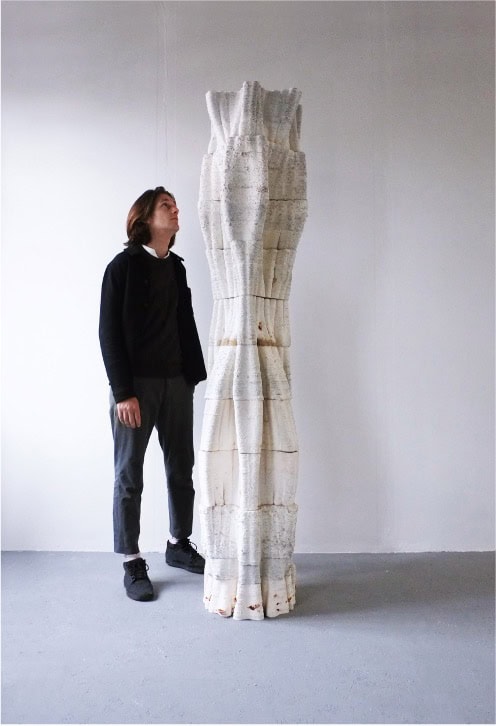
Blaster Studio creates 3D-printed larger-scale projects produced by printing mycelium-based composites which could not be made using a moulding technique. The organic substrate is made from used paper cups inoculated with fungal spawn and made into a biomass paste. The paste is pushed through an extruder and was produces a layer at a time. Each module was 210mm high, ten were produced and stacked form a column which is 2100mm high (Mohseni, et al., 2023)
Conclusion
The findings in this essay have highlighted the constraints when working with mycelium, such as setting up a sterile making space to stop contamination, preparing storage that can be temperature-controlled for the experiments when growing and drying, testing the most appropriate mycelium strains and substrate recipes for each specific application, and anticipating the percentage of shrinkage during the drying process.
A potential research project inspired by the Myco-merge Project (mycelium rattan and hemp) would be to explore a range of biodegradable structural materials such as cardboard tubes, bamboo and willow to make a skeletal substrate for large-scale structural projects. Furthermore, to explore tensile structures made from natural materials such as rattan and other fabrics which can be sources from a waste stream to form moulds designs for free standing mycelium structures.
Finally, we will explore how to add colour to mycelium products, such as using the plethora of coloured PLA filaments to create moulds filled with mycelium and organic paints, dyes, and coatings with mycelium.
KEYWORDS
Mycelium, Biomaterials, Digital Design and Maufacturing, Circular Economy.
REFERENCES & IN TEXT CITATION
Biobased Creations, n.d. Biobasedcreations.com. [Online] Available at: https://biobasedcreations.com/#:~:text=Biobased%20Creations%2C%20by%20Company%20New,a%20regenerative%20and%20circular%20world. (Accessed 31st July 2024)
Biohm , (2023). circularmateriallibrary.org. [Online]
Available at: https://circularmateriallibrary.org/material/mycelium-insulation-panel/[Accessed 1st September 2024].
Biohm: Food Waste to Future Build. (2019). (Film) Directed by Google Talk. London, UK: Talks at Google .
Biohm, (2016). Biohm.co.uk. [Online] Available at: https://www.biohm.co.uk/mycelium (Accessed 7th September 2024).
Bitting, S. et al., (2023). Challenges and opportunities in Scaling up Architectural Application of Mycelium-Based Materials With Digital Fabrication. Fungal Architectures, p. 1.
Dan Den Berg, J. & and Konings, B., (2019). Mycelium Facade Panels. In: J. van den Berg & B. and Konings, eds. Materials Atlas: The Growing Pavillion. Amsterdam: Company, New Heroes, pp. 28-29.
Dessi-Olive, J., (2022). Strategied for Growing Large Scale Mycelium Structures. Biomimetics MDPI, Issue 7, p. 129.
Elise Elsacker, A. S. A. V. W. E. L. d. L., (2021). Growing living and multifunctional mycelium composites for large-scale formwork applications using robotic abrasive wire-cutting. Construction and Building Materials, p. 4.
Fraunhofer Institute for Systems and Innovation Research Oko-Institut, (2013-2020). Methodology for the free allocation of emission allowance in the EU ETS post 2012, s.l.: Frauhofer Institute for Systems and Innovation Research .
Green Trace Architect, 2021. greentracearchitect.co.uk. (Online)
Available at: https://www.greentracearchitect.co.uk/post/mycelium-construction-materials (Accessed 06 Sept 2024).
Jun Yuan Petroleum Group, (2022). What is the difference between EPS fire resistance levels A,B, and B1. [Online]
Available at: https://junyuanpetroleumgroup.com/blowing-agent/what-is-the-difference-between-eps-fire-resistance-levels-a-b-and-b1/#:~:text=EPS%20polystyrene%20board%20itself%20is,)%20and%20B3%20(flammable).
(Accessed 2nd September 2024).
Kaise, R., Brdgens, B. & Elasker, E. a. S. J., (2023). Bioknit: development of mycelium paste for the use with permanent textile formwork. Frontiers in Bioengineering and Biotechnology, 14 july.pp. 1-12.
Mohseni, A., Rocha Veira, F. & Gürsoy, B., (2023). Three Dimensional Printing of Living Mycelium-Based Composites: Material Compositions, Workflows, and ways to Mitigate Contamination. Biomimetics , 23 June.p. 257.
Mohseni, A. & Rocha Viera, F. P. J. G. B., (2023). Three-Dimensional Printing of Living Mycelium-Based Composites:Material Compositions, Workflows, and ways to Mitigate Contamination. Biomimetics, 14 June.
Nguyen, M., Solueva, D. & Spyridonos, E. a. D. H., (2022). Mycomerge: Fabrication of Mycelium-Based Natural Fiber Reinforced Composites on a Rattan Framework. Biomimetics, 8 April, 7(42), pp. 121-133.
Pallister, J., (2014). dezeen.com. (Online) Available at: https://www.dezeen.com/2014/03/06/movie-eric-klarenbeek-mushroom-roots-fungus-3d-printed-chair/ (Accessed 3 August 2024).
Jane, S. et al. (2023) ‘The Living Room’, The Living Room: knitting as a Strategy to Redefine the Architectural Possibilities of Mycelium Biofabrication in the Built Environment , pp. 208–219.
Simpson, S., (2022). Sustainnovation – Mycelium insulation. (Online) Available at: https://www.cundall.com/ideas/blog/sustainnovation-mycelium insulation#:~:text=Agricultural%20by%2Dproducts%20that%20would,tonnes%20of%20carbon%20per%20month.
(Accessed 12 September 2024).
Tiseo, I., (2024). Statistaca.com. (Online)
Available at: https://www.statista.com/statistics/486106/co2-emission-from-the-construction-industry-uk/#statisticContainer
(Accessed 7 September 2024).
Ukpanah, I., (2024). Fibreglass: An In-Depth Examination of its Environmental Impact. (Online)
Available at: https://www.greenmatch.co.uk/blog/fibreglass-environmental-impact (Accessed September 2024).
United Nations, (2022). 2022 Global Status Report for Building and Constrcution: Towards a Zero-emission, Effiecient and Resiient Building and Constrcution Sector, Nairobi: United Nation Environmental Programme.
BIBLIOGRAPHY
Treggiden, K., (2020), Wasted, When Trash Becomes Treasure. Brusseles: Ludion
Franklin, K., Till, C. (2018), Radical Matters: London
Reel, R., San Fratello, V., (2018) Printing Architecture: NewYork